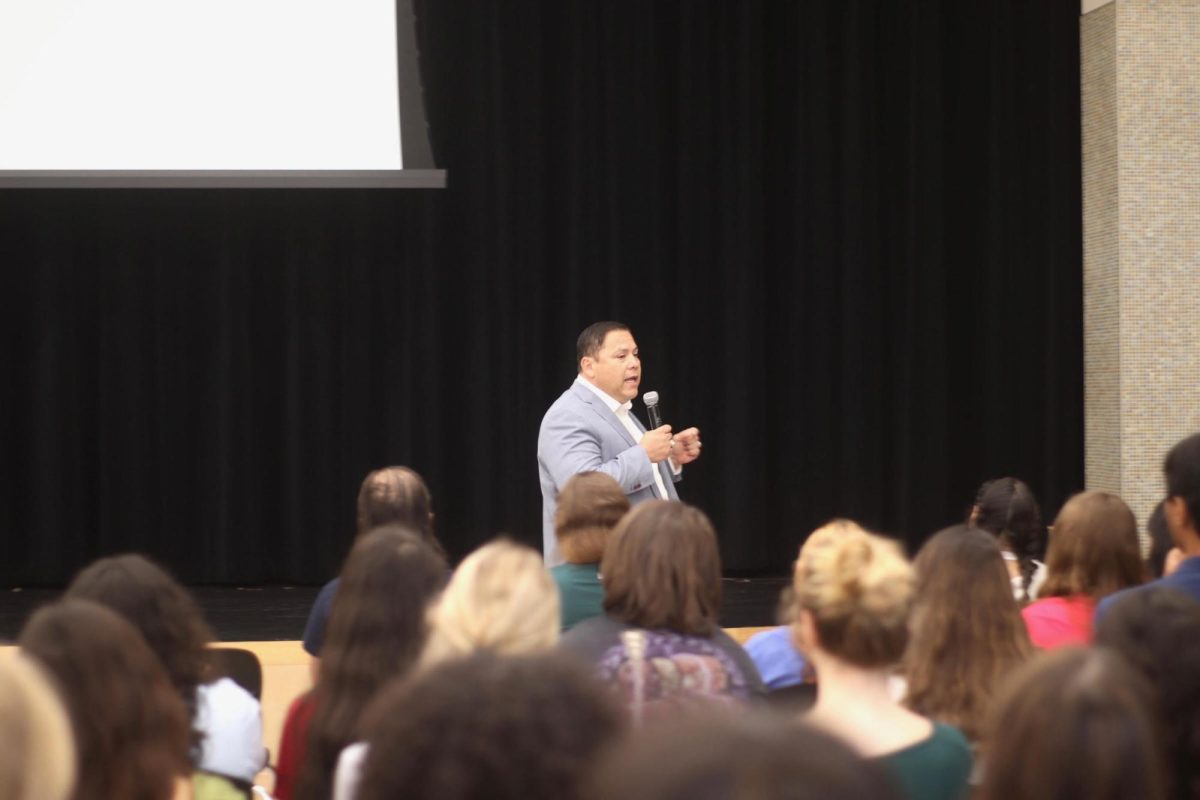
Last Thursday, retired NASA systems engineer and former RHS alumnus George Salazar spoke to students in the cafeteria, sharing highlights from his new memoir, “From the Barrio to NASA.” In his presentation, he shared his journey from his childhood in Corpus Christi to a 40-year-long career at NASA, highlighting his personal struggles, contributions to space exploration, and lessons learned along the way.
Salazar began the presentation by encouraging listeners to embrace unconventional paths: “Some students, at least when I was growing up, went from point A to point B in a straight line. … What you’re going to see is my story is more zigzag than anything else, and swirling all over the place.”
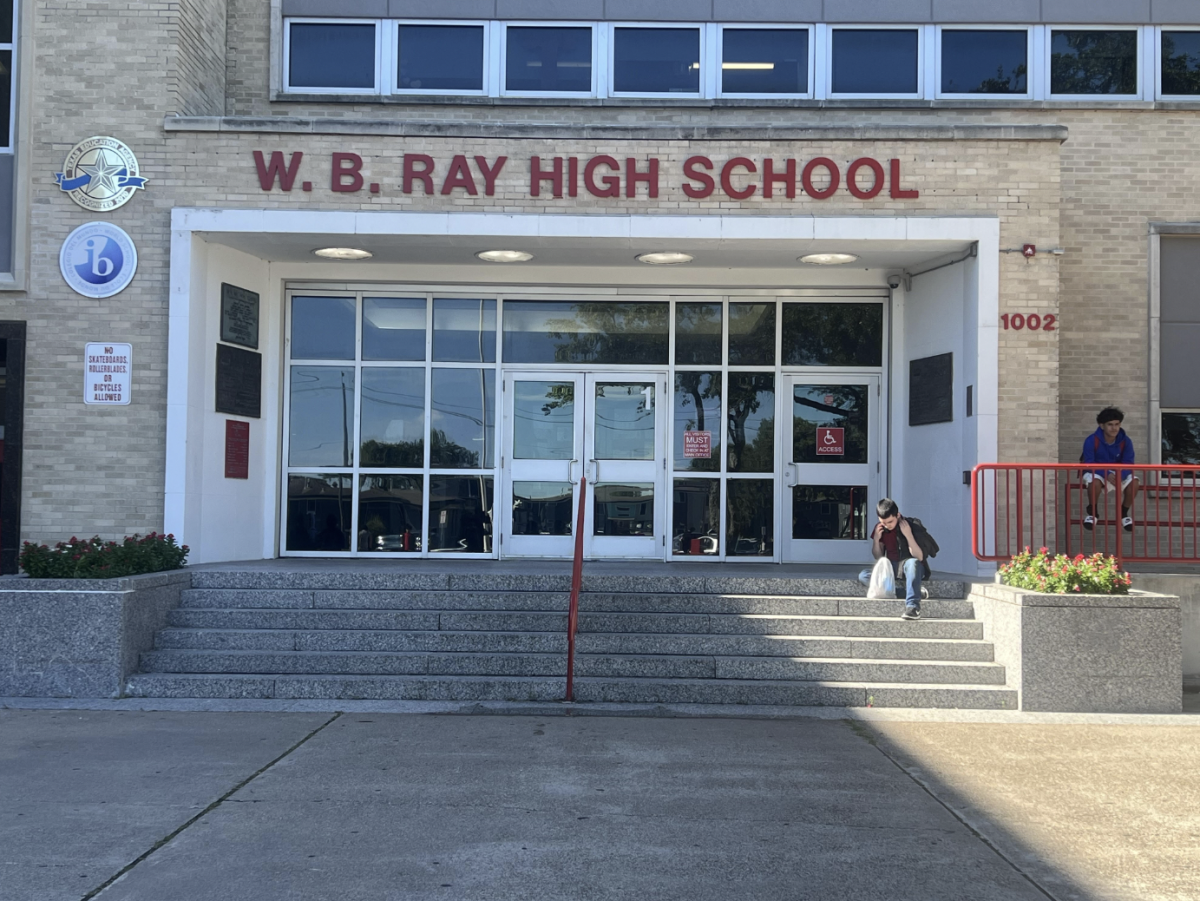
After explaining how his parents had little formal education, Salazar talked about working various odd jobs while attending Ray High School, like working at his family’s doughnut shop:
“Sometimes they gave me the name Doughnut as a nickname, because I always smelled like a doughnut,” he said with a laugh.
However, balancing work and school was challenging: “The things that happened to me in life, in terms of running the business and other activities in my family, made it difficult to keep up with school work. So I did the best I could. I did graduate, and that was the important thing.”
After high school, he attended Del Mar College for half a semester but had to stop due to other responsibilities. Shortly afterward, his family moved to Houston, where he drifted from job to job. After being laid off from construction and quitting door-to-door book sales after just three days, Salazar returned to working at doughnut shops. “There were times where I was working two or three doughnut shop places. … There were times where I was working three jobs and bringing in … three to $400 a week at times,”
However, he decided that his lifestyle wasn’t sustainable and that he needed to pursue a different path. He began exploring opportunities to gain more skills and education, eventually deciding to return to college: “So I took my case, if you will, to a couple of junior colleges. … Harris County College …accepted me on a probation basis. They said, ‘Take four classes; if you make a better average, you can stay.’ I did an A, had an A average on all four, and stayed there.”
Two years later, he transferred to the University of Houston, first starting at the College of Technology, but then switched over to electrical engineering. Eventually, he picked up a job as a calculator repairman and an internship developing geophones used for seismic surveys.
He explained that the internship and previous work experience were a big help in landing one of two open positions at NASA: “So in essence, the (internship, the job at GeoSource) that I had and the donut business… What I did there basically got [the interviewer] interested in me doing another interview. So what he liked about the donut shop was that he was also already gaining time management experience. I was doing basically project management… The project was the donut shop as well as supply chain stuff, you know, making sure that we’re getting the supplies and things necessary for making donuts.”
While he did land the job, he explained that GPA was a big hurdle before and after landing the job at NASA. Earlier on, when he applied for a NASA internship, he was rejected, stating, “My GPA was not high enough. I was only at about 2.5, and NASA doesn’t accept anything less than 3.0.” Even later, as he approached graduation and began interviewing for full-time roles, he reflected that: “I had a GPA of 2.72 for my major in digital systems, and an overall engineering average of 2.5 for the overall engineering curriculum that I took. And so that kind of haunted me, and it made me apprehensive to even apply for jobs.”
He continued explaining that — even after securing the NASA position — he felt intimidated by colleagues from more prestigious schools, due to his low GPA. He described this feeling as a self-imposed roadblock, realizing over time that his accomplishments and experience proved that he did belong:
“And so I thought about it, and I said, ‘Well, wait a minute, I belong here, because I’ve accomplished quite a bit to get to this point.” The important thing for me, for overcoming this, was the family heritage, because I wanted to change the direction that we had in my family,” he stated.
Towards the end of his presentation, Salazar highlighted a few of the many projects he contributed to over his career. One of his first major projects was the Voice Command System, where he served as designer, project manager, and systems engineer. The system, which enabled astronauts to control spacecraft functions using spoken commands, was used on STS-41, the 11th mission of the Space Shuttle Discovery.
He later became the avionics lead designer for the X-38 Experimental Crew Return Vehicle (CRV), overseeing five fault-tolerant computers that exchanged and verified sensor data. Salazar also contributed to the Space Shuttle Cockpit Avionics Upgrade and worked on research involving radiation testing, touchscreen cockpit technology, and how crews adapt to deep-space environments. Toward the end of his career, he participated in conceptual studies for interplanetary landers, including designs proposed by SpaceX and Blue Origin.
After discussing the technical aspects of his career, he shifted towards giving life advice drawn from his own experiences. He emphasized that success isn’t solely determined by grades, stating, “I think success is what you learn, your dedication, your perseverance, and to, you know, work with others.
Before concluding, he also spoke about the value of giving back, explaining that his own accomplishments felt meaningful only when he could help others along the way. “There’s a saying that a writer said, the purpose of life is to find your gift; the meaning of life is to give your gift away,” he said.
Afterwards, Salazar answered questions on topics ranging from careers in aerospace, space exploration, and overcoming challenges. Students who asked questions received free copies of the memoir, with a book signing held after the Q&A.